Tag Archives: horror

Eastercon: Mancunicon convention report 2016!

This year’s science-fiction/fantasy convention EASTERCON took place in Manchester, England. Mancunicon, as it was called, occupied four floors of the iconic Hilton Hotel, a slender glass-and-steel building shaped like the number “1”. The convention gathered together sci-fi and fantasy authors, fans, publishers, gamers and cosplayers. There were almost a thousand people in attendance, and one of them was yours truly.

The Hilton Tower... in the sun.

The Hilton Tower… in the sun.


Now, I’ve been to FantasyCon before and the odd sci-fi movie fan convention. But I’ve never been to Eastercon, so I was unsure what to expect. Fortunately, some friends of mine from the Manchester Speculative Fiction Group were also there, so there was always someone to chat (or moan) to.

The first thing we did was gather at the bar. This was (unsurprisingly) the focal point for the Con. However, the Hilton is a very tall, narrow building so sometimes the bar became very crowded. This never became a real problem, but it did make queuing for the two lifts difficult. The small meeting rooms also meant that several panels were oversubscribed. I was sorry to have missed the panel on rare sci-fi and fantasy TV shows of the 1950s -1970s. But on the whole things ran pretty smoothly.

The atmosphere was, for the most part, very friendly, with everyone united by a love of sci-fi and fantasy. Although some were more hard-core than others – there was a cosplay competition on Saturday for those dedicated enough. I am not the most gregarious person in the world. But even I found myself chatting to a diverse array of people over the weekend.

My writing group has an anthology called “REVOLUTIONS” out at the moment, so this was an ideal place to plug the book. We sneaked up a few posters and shifted quite a few copies. My only regret was that I didn’t manage to prepare any advertising material for my own novel. But then Easter always sneaks up on me.

The events programme was varied and jam-packed. This year’s guests of honour were authors Sarah Pinborough, David L Clements, Aliette de Bodard, and Ian MacDonald. But many more took part, and topics ranged from hard sci-fi to sewing. So there was something for everyone… even a cookery class!

So after catching up with my fellow attendees, I made my way to the first panel…

Welcome to Eastercon – Saturday

This was highly informative and useful. It soon became apparent that Eastercon has a culture all of its own. Some people had been going literally all their lives, while the oldest member was a mere 90 years old.

Afterwards, I browsed the dealers’ rooms. Against my better judgment I gave into temptation and walked away with an armful of beautiful 1970s paperback editions. But some deals are just too good to pass up!

Diversity in SF

The first panel I attended was about diversity in SF/F. This was a very intelligent and nuanced discussion about how difficult it is for authors who are not white and middle class to get published. The speakers made their points with eloquence and precision. Afterwards, I found myself with a far greater appreciation of issues of race and gender.

MSF Group’s “Crit Sandwich” – Saturday and Sunday

Next day, Manchester’s SpecFic group held the first of two long feedback sessions for budding authors. My fellow group members and I reviewed 3 pieces each day of up to 10,000 words per author. The sessions were very enjoyable, with some interesting, varied and (intentionally) amusing samples of work. All those who took part said they found it very useful. I take my hat off to them, as I’m not sure if I’d have had the courage to submit my work to complete strangers at my first Eastercon!

Jo Fletcher Books Launch – Sebastian de Castell

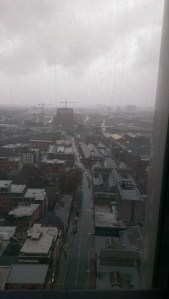
There were several book launches over the weekend. We ascended the lift to the Presidential Suite on the 22nd floor for a reading by the author. The view and the plentiful red wine made this a memorable occasion, and the publishers were open to questions from anyone who attended. Indeed, the wine flowed a little too freely on occasion, with several people complaining of feeling “under the weather” as the Con wore on!
IMAG2824

..And the view from the 22nd storey in the rain.


The Fuzzy Set of Horror

That evening I attended a lively discussion on the boundaries of horror, given by three gothic/supernatural fantasy writers with helpful contributions from horror grandmaster Ramsey Campbell. There were some hotly debated questions about Waterstones’ policy of no longer segregating horror from fantasy and science-fiction as well as on the merits of zombie films.

Later, we sampled the gastronomic delights of Manchester (there are many) before returning to a packed bar and hobnobbing with anyone who would talk to us. But after over ten hours on my feet, I was exhausted. So I limped off to bed to grab four hours’ sleep before Day Three.

Trailblazing Comics of the 1980s – Sunday

Next morning – my head buzzing with a litre of coffee – I took part in my first ever panel. Thankfully, it was a subject I can ramble on about for hours – comic books. My fellow panellists Karen Brenchley and Tony Keen provided the focus of the debate. Together, we discussed which creators shaped the comics field in the 1980s and beyond.

Inevitably, “The Dark Knight Returns” and “Watchmen” were mentioned. But we also managed to include such diverse matters as 2000AD, John Byrne, and “Cerebus the Aardvark”! The attendees called us on our knowledge, so we had to be on our toes. But we all brought something different to the table and managed to give the audience a broad overview of both mainstream and indie comics in the decade. Afterwards, we got chatting to several interesting people. I enjoyed this a heck of a lot and would thoroughly recommend the experience.

Kaffeeklatsch with Sarah Pinborough

Guest of honour at this year’s Eastercon was horror/crime/YA novelist Sarah Pinborough. Fresh from Hollywood, Sarah shared tales of writing and more in this cosy setting. This was a nice change of pace from the panels and a chance to ask more detailed questions of the author. As for the content, I’m afraid I can’t tell you more because, as Sarah says, “What happens in Kaffeeklatsch stays in Kaffeeklatsch!”

Author Reading – open mic

This two-hour session gave authors a chance to read their own work. My nerves were set on edge by the announcement that it was to be a competition. When the “judges” were given sticks with numbers on, the whole thing took on the aspect of a David Lynch film. Authors read their works until a gong signalled they had run over the time limit, whereupon the judges gave the scores. Fortunately, the whole thing was just a bit of fun. The readings were diverse and entertaining, and the host excellent. Although I really felt for one poor chap who had only written his piece that morning.

SF Pub Quiz

Late on Sunday, we took part in the hardest pub quiz I have ever seen in my life. Categories ranged from “Name the scientific instrument” to “Name the TV theme tune… and composer”. Needless to say, our score was abysmal!

By this stage everyone was relaxed and the party mood was in full swing. It was with a heavy heart that I retired to bed in the early hours, knowing that there was only half a day to go.

The Deeper the Grief, the Closer to Life – Monday

By Monday a few people were looking the worse for wear. But a crowded audience still packed out the main room to listen to a panel about grief and loss. Despite the heavy subject matter, the talk proved to be worth waiting for. Authors Sarah Pinborough and Neil Williamson discussed writing about grief, as well as recounting real-life tales, both sad and funny. This was definitely one of the better talks, although I can’t really remember why!

Criminality in SF/F

The final panel of the day got a little raucous at times, as several authors discussed the representation of crime in sci-fi and fantasy novels. By this stage we were all just relaxing. Some great debates arose, though. One of which may have just given me an idea for my next story…

In Conclusion

Eastercon was something of an unknown quantity for me. At first I found the fan-based culture a little intimidating. But having it in Manchester helped my travel plans and allowed me to stay much longer.

Given the unique challenges of the Hilton tower, the organisers did their best to keep things running smoothly. Volunteers were always present to help, and being on a panel was tremendous fun.

If I had any suggestions it would be to offer more author readings and to include more horror. At the moment, Eastercon is quite “sci-fi heavy”.

So will I be going to another Eastercon? Hell, yeah. I’d recommend it to anyone and everyone who likes genre fiction.

Will I be more prepared next time? Definitely!


Top Horror Clichés The World Can Do Without!

Let’s get down and dirty in this post by exposing some of the worst horror movie clichés out there. Some of these – like the axe-murderer in the back seat – are so old I’m not even going to talk about them. Instead, here are some of the more insidious violators of the audience’s desire for something new. Most of these are lazy, cynical ways to make a movie. Don’t let them find their way into your screenplay!


Just because you know you're using a cliché doesn't mean it isn't a cliché.

Just because you know you’re using a cliché doesn’t mean it isn’t a cliché.


Girl trapped in the basement of a serial killer

We’ve all seen this one. A hot girl gets kidnapped by a serial killer and spends the next two hours screaming, trying to break out, breaking out, getting recaptured, and finally killing the serial killer. Yes, it’s zero budget. It’s also zero-entertainment. If there ever was a point to telling a story like this, it was done in “The Silence of the Lambs” over twenty years ago. Please, no more!

People in a bunker

In the 1960s shows like “The Twilight Zone” used this setup to tell thought-provoking stories of bigotry, prejudice and paranoia in a Cold War age. Today, it’s an excuse for a low-budget movie. If your movie isn’t a political allegory, avoid this cliché. In fact, even if it is avoid this cliché.

Group in a haunted hospital/abandoned building/old house etc. etc.

A group of unfeasibly hot scientists/investigators/college kids go snooping around in a big old building. Of course they can’t find their way out once they’re inside. It’s haunted, you fools! Cue ghosts, demons, a serial killer etc. If you’re going to tell this story, you better have one very cool monster. Oh, and those smart-alec kids/investigators? They’re really annoying.

Sexy vampire/werewolf/warlock/witch etc.

Must be incredibly hot, twenty-somethings and dressed to kill. Uh, not literally. No, because these beautiful creatures won’t be doing any killing. They’d sooner get it on with each other! In these stories – allegories for wealthy high schools and colleges – we usually sympathize more with the villain who is trying to bump off as many of his classmates as he can – until of course he starts spouting those cheesy lines of dialogue.


craft 51yh9pb+kQL._AA160_

Spot the difference? That’s right, the one on the left made more money!


Shoulder touch

Picture this: your girlfriend is wandering alone through a scary old house/asylum/abandoned hospital/hillbilly shack etc. You see her and decide to get her attention. How do you do it? Call her name? Cough loudly? No, you creep up to her silently and grab her shoulder. Watch how she screams! This ploy also works when you reverse the genders. Seriously, what’s the matter with you! Oh, it was an excuse for a cheap scare by the writers. Ah…

Medicine cabinet scare

Basically any scene where someone closes a mirrored door and sees a face behind them. Or closes the refrigerator and someone is standing there. How did they get there? Are they wearing cushioned slippers so they couldn’t be heard? Damn those psychos and their cushioned slippers. Oh, and this one works ever better if you have some “jump scare” music as well.

The double twist

So you’ve reached the end of your boring slasher movie. Now what? What this movie needs is… a double twist! So now the final girl gets killed, and it’s the not-so-final girl who survives! Or maybe the final girl has hallucinations that she’s being stalked by the killer even though she’s safely strapped to her psych ward bed. She’s a basket case. The horror! First popularized in Brian De Palma’s version of “Carrie” in the Seventies. Nowadays, it’s just another excuse for a cheap plot twist that robs the film of any emotional payoff it might have had.

Nothing can stop Milla Jovovich, not even plot tension.

Nothing can stop Milla Jovovich, not even plot tension.

The kick-ass heroine

“The Matrix” has a lot to answer for. Floor length PVC coats. Funky spectacles. Kung fu fight scenes. But one thing we can do without is the kick-ass heroine. Impossible to defeat, able to take out 250-pound gorillas despite looking like she never even hits the gym, this frail-looking hot girl can punch holes through solid steel and perform improbable back flips. Sometimes explained by SCIENCE. Sometimes not. Next time you see a hulking serial killer who has spent his life stalking and murdering humans taken out by a five-foot co-ed with a stick, you’ve met the kick-ass heroine.

The dumb jock

If you thought this was a stereotype, you’d be right. It’s a well-known fact that any male who does sports in high school is a sexist bully with a brain the size of a hen’s egg. You can usually spot this character by his natty baseball top and rippling muscles. Whatever the most sensible course of action is, he will oppose it. Even if he has just seen his friends get ripped apart by a murderous sasquatch, he will run into the woods and chase the monster down armed with nothing but a wet towel. But it’s the way he badmouths his girlfriend that seals this character’s doom, because he just insulted the movie’s target demographic!

Loss of cellphone reception

No matter how extensive your network coverage, you can bet that your cellphone will start to misbehave at a crucial moment. This is most likely to happen just after the first death occurs in your party. No matter how expensive your pricing plan, your movie phone is not going to save you now. You see how I just isolated the characters so the monster can pick them off one by one? Genius!

Any kind of hybrid monster, e.g. Sharkspider vs Mechacrocodile!

Most of the said monster will be rendered in appallingly bad 1990’s computer animation. Sharks are the favoured creature of choice, modified by a mixture of sabretooth tiger, giant snake, octopus, robot, crocodile, or whatever graphic the CGI animator has to hand. For bonus points, find a ridiculous way of getting your aquatic monster onto dry land. Ghost Shark, anyone?


A truly terrifying postmodern serial killer.

A truly terrifying postmodern serial killer.

OMG it’s just so postmodern!

If you’re too cool for regular horror tropes you might just want to go full postmodern. In this kind of movie, the teens know all the rules for serial killer movies. They endlessly reference plot points from horror films, thereby continually reminding the audience that what they’re watching is in fact only a movie. Used ad nauseum in the “Buffy The Vampire Slayer” TV Series and to varying effect in the “Scream” movies, this irritating glitch makes us want to punch our TV sets as hard as possible while yelling “Shut up talking about horror movies and show me a horror movie!” This type of movie is often coupled with the Double Twist. Because OMG, it’s just so postmodern!

There are plenty more bad clichés out there, clichés so ugly they should have been destroyed at birth. But these are the ones I keep seeing over and over again in modern horror movies. So before you rush out to make the latest girl-trapped-=in-a-basement-by-a-serial-killer movie, please check out this list.

As for a big budget tentpole horror movie set in a bunker by one of Hollywood’s top directors… that couldn’t happen nowadays, could it?


My top 20 horror novels of the past 70 years!

As it’s almost Christmas, here is a list of my own favourite horror books. These are books that either inspired, terrified me, or made my jaw drop at the sheer beauty of the writing. These are all personal choices, so feel free to disagree. But without further ado, here is the list, in no particular order…


rats

The Rats James Herbert

British writer James Herbert was strangely underrated during his lifetime, which is a shame, as he is one of the most frightening horror writers of the 20th century. “The Rats” burst on to the scene in the 1970s, and it still packs a punch today. The huge list of characters, the violence, and the incredible imagery make this a must-read!

Cabal Clive Barker

In the 1980s Clive Barker appeared as a breath of fresh air with his promise to show what other writers only hinted at. Not satisfying with having the monster carry off the maiden, Barker wanted to reveal what happened afterwards. Cabal is his most solid novel, a tale of a man who believes he is a psychopath and takes refuge in a hidden underground city of monsters. The result is a Grand Guignol of the surreal and unnerving. Filmed as the uneven but imaginative “Nightbreed” with David Cronenberg as the bad(der) guy!


king

The Stand Stephen King

My first Stephen King entry is the author’s dark take on the apocalypse. It begins with a whimper and ends with a bang.  Filmed twice with varying success, this is some of King’s finest writing. So depressingly realistic that at first I had to give up on it and came back when I was in a lighter mood!

IT Stephen King

The second Stephen King entry on my list is, I think, undeservedly ignored, thanks to a forgettable TV movie. But make no mistake, the novel is King at the peak of his powers. The characters are rich but archetypal, the town of Derry both nostalgic and terrible. And the monster, ah, the monster..!


The Doll Who Ate His Mother, Ramsey Campbell


A peculiarly British atmosphere pervades this book, set in the poor end of Liverpool. There is a particularly nasty antagonist, but what makes it so memorable is Campbell’s description of urban neglect. Wherever the characters go you feel the empty eyes of forgotten tenements glaring at them. A unique little tale.

bradbury

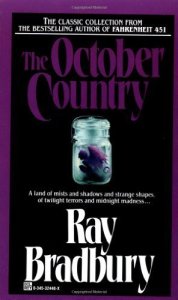
The October County Ray Bradbury

Few can deny that Ray Bradbury is the American master of the short story. But did you know that this anthology contains an early possible prototype of the Addams Family? These American Gothic fables contain such memorable tales as “The Jar” and “The Emissary”. Packed with gorgeous prose, this is both horror and literary… and funny to boot!

Domain James Herbert

The last entry in the “Rats” series sees survivors of a nuclear holocaust eking out an existence in London’s rubble. Until they find an army of mutated rats waiting for them! Superlative suspense fiction. Every chapter ends on a cliff-hanger. Surely a Hollywood blockbuster waiting to be made!

The Vampire Tapestry Suzy McKee Charnas

A unique take on the vampire genre sees Suzy Charnas’s ancient and wily vampire take on the challenges of the modern world. Never has a vampire been presented in such a detailed psychological light.

The Books of Blood Clive Barker

Yes, all of them! It’s hard to imagine how revolutionary Barker’s fiction was when it first surfaced. These short stories run the gamut from the epic (In the Hills, The Cities) to the eerie (Skins of the Fathers), the surreal  (The Body Politic), the funny (The Yatttring and Jack) and the downright weird (Son of Celluloid). Some have become movie fodder, such as the unforgettably bizarre video nasty “Rawhead Rex”. Others are allegedly in the pipeline. But nothing can prepare you for Barker’s very personal vision of a contemporary world that’s as dark and corrupted as Dante’s inferno!

Interview with The Vampire Anne Rice

The book that launched a publishing legend. I still remember getting lost in the luxuriant Gothic prose. Anne Rice creates a vivid fantasy fever dream that is both like and unlike the movie version. A true masterpiece of fiction.

triffid

Day of the Triffids John Wyndham

British writer John Wyndham’s most well-known book is an example of the “cosy catastrophe”. But that’s why I like it! It’s interesting to see stiff upper lips drop as British society falls apart under attack from some walking plants with the aid of a meteor shower!

Kiss Kiss Roald Dahl

Not just the writer of Charlie and the Chocolate Factory, Dahl’s short stories were laced with an acerbic wit and grisly imagination. A bit like fairy tales for adults, with added poisoning, brain surgery and insect/baby hybrids!

Ghost Story Peter Straub

Possibly THE great American ghost story. Peter Straub writes far too little horror these days. But this fantastic novel – described by Stephen King as “a tiger tank of a book” – contains virtually every twist on the ghost tale that you can imagine. Oozes atmosphere and quiet menace!

legend

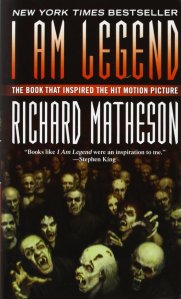
I Am Legend Richard Matheson

With episodes of “The Twilight Zone” and numerous TV movies such as the unforgettable “Duel” and “The Night Stalker”, Richard Matheson inspired a generation of writers.  This is his probably his most famous work – filmed as the languid Vincent Price chiller “The Last Man On Earth”,  the action-packed and very Seventies “The Omega Man” with Charlton Heston, and lately as the CGI-heavy Will Smith popcorn flick, this tale of a man alone in a  world of vampires  has still never been done right. Which is a shame. It’s a fine novel.

The Haunting Shirley Jackson

One of the great ghost stories ever written, it’s amazing how the writer delivers so many effective scares without ever resorting to gore or shocks. Shirley Jackson’s story is a snowball rolling downhill, gathering chills as it goes. Also one very good and one very bad movie.

Teatro Grottesco Thomas Ligotti

Ligotti is one of the writers of the “new weird” – modern authors in the cosmic horror tradition of HP Lovecraft. This collection showcases his unique prose style – a style of flatness and repetition – that lends his words a peculiarly terrifying banality. “The Red Tower” was a particularly fine story. Have fun unpacking the symbolism!

Hour of the Oxrun Dead Charles L Grant

Overlooked by many, Charlie Grant’s Oxrun Station stories all take place in the same sleepy Connecticut town – that just happens to attract all manner of evil! Perhaps it was because these are classic supernatural stories that came out just as writers like King were modernizing old horror tropes. But these are creepy tales, laced with luscious prose. The old TOR versions had the best covers – each one a gorgeous Halloween-themed scene. Ideal for a creepy night in!

grant

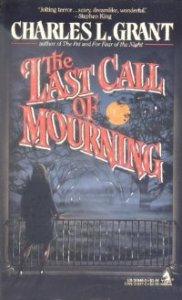
Last Call of Mourning Charles L Grant

My favourite Charlie Grant story keeps you guessing all the way through. The plot sounds simple enough – the heroine returns to Oxrun Station to find her family ‘changed’. They don’t bleed, keep out of the sunlight, and have strange nocturnal habits. But the truth is something you’ll never guess. A masterful book that drips atmosphere and charm.

The Beautiful Thing That Awaits Us All Laird Barron

Barron has erupted onto the horror scene in recent years. This volume represents many of his Lovecraft-meets-Raymond-Chandler style of stories. But that is to do him an injustice. True, “Hand of Glory” is an effective pulp/horror mashup. But other stories show a genuine ability to expose our innermost fears. His eye-catching imagery cannot be easily forgotten.

The Vampire Lestat Anne Rice

Anne Rice second entry in my list is, I think, the most rich of her vampire stories. While I loved the epic scale and sheer ambition of “The Witching Hour”, “The Vampire Lestat” beats it because of the wonderful ironies the author employs. Here we learn who Lestat is, where he came from, his complicated (to say the least) relationship with his mother and his first meeting with Armand. We also learn more about Rice’s vampire mythology. This is both epic and deeply personal. Lestat feels like a living, breathing person. In all of horror, I can’t recall a more well-rounded, charismatic character!

Afterword

What’s missing from this list? Plenty. This is not my “Top 20”. Nor is it meant to be any kind of definitive list. These are just books I’ve loved. Pure examples of the horror genre that are original stories. I’ve not included anything by any “classic” author such as HP Lovecraft, Mary Shelley or Edgar Allen Poe, because everybody knows all about them anyway. Hopefully you feel the same or similar about some of these titles, or if not, I hope you seek them out and find them to your liking!

Enjoy!

Revolutions Anthology


msf

Publication looms for the superlative Manchester Speculative Fiction Group anthology “Revolutions”, as the proof copies are being checked for last minute spelling and punctuation as we speak!

This promises to be an awesome collection of stories, folks. The Manchester Speculative Fiction group has been going for some years now, but this is our first anthology. It showcases not only work by group members, but by many talented writers across the world. The only criterion was that all the stories had to be set in Manchester, England. Whether this is the Manchester we all know and love (it’s currently pouring with rain as I’m typing), or a future, past or alternative Manchester was left to the writers. So expect the unexpected!

This is an exciting time for myself and the other editors. More details will follow nearer the launch date.  I just couldn’t wait to share these pics with you all!

Until next time…

The Many Different Types of Horror Movie Scare!

What techniques do horror movie makers use to make a film scary? The answer is, many. Serious critics often vilify horror movies as cheap, vile “video nasties”.  But in reality, a horror movie is a complex machine. Some of the best ones operate on many levels. So today we’re going to examine just what makes a horror film scary.

I’m not talking about monsters or violence. Instead, I’m talking about the methods writers and directors use to make us jump out of our skins or hide behind the sofa (don’t tell me you’ve never done that) in our favourite scary films!

This is by no mean an exhaustive list of the types of scares to be found in horror movies. But here are the ones I’ve noticed a lot.


Cat Scares and Hidden Attacks abound in

Cat Scares and Hidden Attacks abound in “Alien”!

The Jump Scare

The laziest kind of scare. The hero or heroine is walking around the creepy old house when BOO! It’s the monster! Usually it leaps straight at the camera so we experience for the shock ourselves. This is the kind of scare that easily gets on your nerves. For a classic example, see the “head in the boat” scene in JAWS. Check out many modern movie trailers for more inept examples.


The Lewton Bus

Also known as the “Cat Scare” or “Faux Scare”.

Ever noticed how sometimes the hero or heroine will be walking through the dark old house/deserted spaceship looking for the monster, when suddenly BOO! out jumps the monster. Oh wait, it’s not the monster after all. It’s only the cat. Or maybe it’s the boyfriend that puts his hand on the heroine’s shoulder. You’ve just been played for a sucker.

The origin of this term is legendary film producer Val Lewton, who used this to great effect in the classic original THE CAT PEOPLE (1942). If you’ve never seen it, get yourself a copy. It’s been ripped off hundreds if not thousands of times since.

“Nested” Cat Scare

A modern twist on the Cat Scare is that right after the innocuous event the real monster DOES appear! This would be more interesting except that it’s also been done a thousand times. For a more interesting variety, check out AN AMERICAN WEREWOLF IN LONDON. Our hero has a terrifying dream involving a monster with a knife. He wakes up to find… his nurse leaning over him. She goes to the window, opens the curtains and…BOO! The monster jumps out from behind the curtains and stabs her in the chest. Our hero screams. Then he wakes up again. The nurse is there and she goes to the window. She draws the curtains again and… nothing happens. A very unsettling scene.


 Mirror Scares / Reveal Scare

How many times have you seen the hero or heroine go to the bathroom, open the mirrored bathroom cabinet (it always has a mirror, doesn’t it?), close it again and… BOO! There’s the refection of the monster right behind them in the mirror! Modern variants include refrigerator doors with monsters inexplicably appearing behind them. Once again, this has become a massive cliché. Still pretty scary, though.


Loud noises

A relative of the jump scare.  But instead of seeing something, we hear it. For a recent example check out the PARANORMAL ACTIVITY movies. Although here the scare is used quite effectively, as the loud noises build up over each night, making the audience dread each sundown more and more. And, of course, they are very inexpensive to create!


Hidden attack

Typically, this very effective scare hits us from another direction from that in which we were looking. Not to be confused with the Cat Scare, which is supposed to get us on the edge of our seat before the attack happens. This scare comes out of nowhere. It’s a bolt from the blue.

Done well, this is one of the best scares. A classic example is the infamous chestburster scene from ALIEN where the creature explodes out of John Hurt’s chest. But other examples can be found. John Carpenter’s underrated THE FOG contains several of these. There’s also a great one in EXORCIST III. The camera sits at the end of a long hall in a hospital. A nurse sits at the desk, doing paperwork. Other people come and go. The nurse goes to check the rooms. She walks up the corridor. Behind her, very subtly, the other people leave one by one. She locks the last door, turns to go into the room opposite and BOO! What is that behind her? The monster explodes out of the locked doorway with a very nasty set of surgical scissors in hand. You’ve just been caught out by the Hidden Attack!


Suspense

This technique has been described as what happens when the audience knows as much as the character on screen. We’ve all seen those films where the hero or heroine (more probably) approaches the door, knowing there’s a killer/monster on the other side. They open the door slowly and …. BOO!

Nowadays this is pretty clichéd. Modern viewers tend not to buy this setup. There’s no way anyone with half a mind would go towards the location of a dangerous lunatic or hungry monster. So filmmakers try to find increasingly bizarre ways of getting the character to go towards the fear instead of away from it. Personally, if I never saw a character go toward the monster again, I wouldn’t mind. Sometimes it’s best just to accept that certain things are no longer scary.

Hide and Seek

According to Alfred Hitchcock, one of the greatest ways to create suspense is to employ what’s called Dramatic Irony. This is where the audience is aware of a menace that’s creeping up on the unsuspecting hero or heroine. Classic examples of this scare include the original HALLOWEEN (1978). This has pretty much been done to death (no pun intended) by the Slasher genre. By now the audience has become so familiar with it, it’s almost like an in-joke for the crowd. See the SCREAM movies for pastiches on this technique.


Mystery POV

A cousin of “Hide and Seek” is the Mystery POV, also known as the Dark Intruder POV. Here, the camera becomes the eyes of the killer/monster. We see it approach the unsuspecting victim. Classic examples include JAWS, when we see the unsuspecting swimmers paddling in the sea from below. Suddenly the camera rushes up to those dangling legs and… CRUNCH!

It’s a strange technique in that it sometimes arouses sympathy with the killer! Italian cinema has often used this technique to jarring effect. The Giallo films of Dario Argento, such as DEEP RED, often show us the killer preparing to commit (and committing) increasingly bizarre murders. It’s a sort of comment on how, just as audiences like to be scared, they might also be enjoying the thrill of seeing the murders onscreen. Creepy.

Endurance horror

This is an interesting technique. Films such as the original THE EVIL DEAD (1981) were marketed as “endurance horrors”. The basic idea is that you throw so much at the audience that they can’t take any more. Eventually, the slightest thing sends them over the edge and leaves them a quivering bundle of nerves. THE TEXAS CHAINSAW MASSACRE (1974) is a great example of this. By the time we get to the crazy “feast” scene at the end of the movie, the heroine (and the audience) are emotional wrecks!

Birds Film

Claustrophobia and suspense in Alfred Hitchcock’s “The Birds”!


Repulsion

Another lazy technique. This just means making the audience want to gag. In the hands of a master, like body-horror maestro David Cronenberg (THE FLY, SHIVERS) it’s truly terrifying and will stay with you for life. In the hands of anyone else, it’s just yucky. Bad examples abound, I’m just not going to go there.


Surreal Scare

My favourite kind of scare. This happens when you see something that looks so startlingly out of the ordinary that it’s frightening. It’s a “Thing that should not be”. Classic examples include David Lynch’s ERASERHEAD… or practically anything by David Lynch.

My favourite example is the famous vampire boy from the TV movie SALEM’S LOT (1979). Here, a boy awakens one night to find another recently deceased boy floating outside his window, scratching to be let inside. He foolishly opens the window. The dead boy floats in. He’s pale, rotting maybe. He has yellow eyes, long teeth and he’s very, very hungry. An extremely scary scene indeed.

Fear of the Unknown 

Horror writer HP Lovecraft once said that the greatest fear of mankind is the fear of the unknown. Some horror movies play on our sense of dread at not knowing what lurks within the darkness. The Found Footage horror genre uses this one a lot (primarily because it involves not seeing anything and is therefore cheap). At crucial points all the lights will go out. Cue screams, banging and general terror. Examples include THE BLAIR WITCH PROJECT, which proves that sometimes it’s what you don’t see that’s more frightening.

Phobias

A close relative of the “Repulsion” technique, except that this involves repeatedly showing us images of something we find scary. Often this involves animals. Sharks, spiders, snakes, parasites, wolves, diseases, all these things are pretty scary. Or it could be a fear of flying, falling, the ocean, dismemberment, disfigurement or other types of grisly death. Examples include SNAKES ON A PLANE. However, you can forget the rather unscary ARACHNOPHOBIA.

Claustrophobia is another sub-type of this scare. The original DAWN OF THE DEAD (1978) uses this to excellent effect. The heroes are all trapped in a shopping mall with hundreds of zombies. The undead might be slow, but there are so many that escape is impossible. The classic shot from that film occurs when a character thinks himself safe in an elevator, only to be swamped by zombies when the door opens. This type of scare lingers long after the film ends.


Loss Of Identity

What’s more scary than dying? Losing your soul, of course. Horror movies recognize this. Many classic genre tropes like werewolves, vampires and zombies prey upon out fear of losing our sense of self, that thing which makes us who we are. The undead are not our real loved ones; they are unthinking, hungry shells out for our blood! Smart movies play with this type of scare. One of the best is THE INVASION OF THE BODYSNATCHERS (1956). We crawl with terror as people slowly lose their identity and are replaced with the hive-minded, unfeeling pod people. And when you are the only real human being left… well, that’s a truly frightening prospect!

The Chase

Chase sequences abound in horror movies. It’s a close cousin of the “suspense” scare. Both we and the character know there’s something right behind them, trying to catch up. THE TEXAS CHAINSAW MASSACRE employs the classic example of this as the chainsaw-wielding Leatherface pursues the hapless heroine through the woods.


Atmosphere

This is less common nowadays and has become a cliché. In the early days of horror cinema it consisted of an old dark house, scary inhabitants, flickering lanterns, lightning storms, etc. etc. The old Universal horror movies of FRANKENSTEIN (1931) and THE WOLF MAN (1941)  contain many examples. However, something of this still survives in so-called J—Horror, which subverts this type of scare.  Here, ghosts pop up in banal places, like modern Tokyo, Internet chat rooms, or tenement buildings. See the Japanese originals of THE GRUDGE, PULSE, and DARK WATER for examples.

So there you are, my main types of horror movie scares. Doubtless I’ve omitted a few, so feel free to correct me. Now go out there and scare the pants off people!

Link

Hi folks! Just wanted to let you know the deadline for submissions to the Manchester Speculative Fictions group’s anthology, “Revolutions” is fast approaching! The closing date is May 1st and there are still some spaces available.

You do NOT have to be a member of the group to submit. Submissions are invited from everyone and everywhere.

?????????????????????????????????????????????????????????????????????????????????????????????????????

What We Want

Stories should have some connection to Manchester, England. They should also contain some element of either science-fiction, horror or fantasy.  When we say “should”, we mean “must”!

Stories should be 1,500-6,000 words long.

Here’s what we’ve noticed so far…

Some stories have absolutely no connection to Manchester.

Some stories have no ending. The story starts out well, and then suddenly stops dead. Or nothing happens at all. It doesn’t have to be full of action, but a story should have some kind of point or resolution.

What You Get 

£10 payment per story accepted. Payment is by Paypal. Electronic publication. See my previous post here [https://ericiansteele.wordpress.com/2015/02/02/submissions-call-for-new-anthology-revolutions/] for a full list of terms and conditions.

How to Submit

Stories should be sent as Word attachments in standard manuscript format to msfantho [at] yahoo [dot] com. In the subject line please put: “SUBMISSION: [Story Title] by [Your Name]”.

The best movies of the 2010s so far!

TheMaster_Aceshowbiz-300x199

So for some reason it’s time to take stock of the movies made in the 2010s so far. Well, it would be remiss of me not to have my own Top 10 movies of the decade. Here’s a big disclaimer, though: these are just the movies I’ve seen. Some very recent movies (including a couple of Academy Award winners) are not among them. Anyway, here goes…

10. Thor

Why: Because it made the surfer look cool again. And it also gave us Tom Hiddleston. Kenneth Branagh’s rip-roaring take on the thunder god was just what Marvel needed. A genuinely fun romp, brilliantly executed.

9. Inception

Why: It’s Chinese Puzzle of a plot proved that audiences are more intelligent than they are given credit for. Some jaw-dropping SFX helped too. But mainly it was Christopher Nolan’s refusal to spoon-feed the viewer with easy answers that won me over.

8. Tron Legacy 

Why: Because it made synthesizer music trendy again. A killer soundtrack and incredible SFX made this underrated blockbuster a must-see. As well as being faithful to the original movie, it included such breakthroughs as a 30-years-younger Jeff Bridges fighting with himself. Oh, and Olivia Wilde. A visually stunning and practically perfect action movie.

7. Guardians of the Galaxy

Why: It made “I Am Groot” part of popular culture. A very funny old-school action/comedy that just happens to be set in the Marvel universe. It also has some of the most memorable characters I’ve seen on screen for a long time – especially one psychopathic raccoon and a very literal-minded alien. Writer/director James Gunn never allows the excellent SFX to dictate the story and doesn’t fall into the trap of logically impossible action scenes.

6. The Conjuring

Why: A terrifying movie-going experience, right from the opening titles. This is horror on steroids. The plot is old-fashioned, but the movie is executed in one bravura set piece to the next. Classic horror.

5. Seven Psychopaths

Why: Postmodern, irreverent, full of grindhouse-style violence. But for me, Chis Walken and Sam Rockwell’s acting steals the show. The violence is played for laughs, but there’s also a real heart to the story that makes us question all that movie bloodshed we see so much of nowadays.

4. The Way Way Back

Why: A movie that perfectly captures adolescence. This is the kind of family comedy they made in the Eighties, but with a modern sensibility. Steve Carell is truly loathsome as the passive–aggressive antagonist. While Sam Rockwell turns in another masterful performance. Thirty years ago, Bill Murray would have done the same thing.

3. The Master

Why: The terrific acting holds together this rather quirky “institutionalized” drama. Joaquin Pheonix is a smouldering presence, inviting us to figure out what’s bugging him. It’s a pleasure to try to unravel the characters’ psyches while we watch them onscreen.

2. The King’s Speech

Why: A masterful talking-heads picture with some terrific low-key drama. There are no explosions or spaceships here, just stuffy drawing rooms and restrained performances. But it’s a movie that knows what it’s about and does it superbly, hitting all the right emotional notes.

1. The Artist

Why: What’s not to like about this movie? It’s a silent, black and white film made over 80 years after the first talking picture. But it’s not just a spoof or an homage. It uses silent film as a genre, almost as a metaphor. When sound does intrude upon the action, it’s a truly memorable moment. Some great performances with no dialogue underline this masterpiece of cinematic art. And it features one of the greatest dogs in movie history!

So there you have it. My top movies of the decade so far. These are, of course, based on my own personal tastes, although I’ve tried to include something for everyone. Feel free to tell me I don’t know what the heck I’m talking about. But for me, these were the real standouts.

Submissions call for new anthology – Revolutions!

We at The Manchester Speculative Fiction Group are publishing an anthology to showcase speculative fiction with a Mancuian theme. The anthology, titled “REVOLUTIONS” will contain a mix of science-fiction, fantasy, and horror fiction. Submissions are currently open, and anyone over 18 years of age can submit.  You don’t need to be a member of the group. We welcome submissions from anywhere and anyone (see rules below).


?????????????????????????????????????????????????????????????????????????????????????????????????????


The theme is Manchester. All stories must be linked in some way to the city of Manchester, England. In all honesty, we really haven’t worked out anything beyond that. We’re hoping that a clear link between all the stories chosen will reveal itself. You don’t have to live here, but each story should have a flavour of the real Manchester.

Manchester is more than just a name. Like it or loathe it (or both!), it’s a place – a very wet place – full of lots of different people. In the Nineteenth century it was one of the biggest, if not the biggest, cotton mill town in the world. The city is still criss-crossed by canals where barges used to tow cotton to the factories. Its damp climate was specifically chosen so that the cotton remained moist. Manchester was also the scene of several historical incidents such as the terrible Peterloo Massacre, plagues, and the invasions of both Bonnie Prince Charlie and William Wallace. Dig a little further, and you can find traces of the original Roman town. The city has changed a lot in recent years. Its fame as a city of football is worldwide. The British Broadcasting Corporation is based here. It’s also one of the most multicultural cities in the United Kingdom.

But why am I doing your job for you?

Dig deep into the inkwells of your imagination to provide us with stories of thrills, technological marvels, alternate realities and urban fantasies. Does some of this sound contradictory? Yes? Well, that’s the point! If in doubt, write it out.

Please read ALL of the guidelines BEFORE you submit:

1. Closing Date

Submissions window is from now until 1st May 2015.

2. Eligibility

Anyone over 18 can submit from anywhere in the world.

3. Theme

All submissions must be in a speculative genre (sf/f/h/df/uf/slipstream) and must have some link to the area that is Greater Manchester, England. The final decision about whether a story is to be included in the anthology will be the editors’ within their absolute discretion. Don’t think you can just change the place names in your old stories. We notice things like that!

4. What we give you

£10 payment per story accepted. Payment is by Paypal.

5. What we get

First Print Rights and Electronic Publishing Rights for 12 months. We reserve the right to archive your story online indefinitely. Please bear in mind that most publications will not publish pieces that have been published in print, eBook, or on the web, so for all intents and purposes after your work is published by us it can only be marketed as a reprint, which severely limits the number of markets that will accept it, and drastically reduces the pay rate it can receive. It is up to you, the author, to decide if this is what you want to do.

6. Word Count

Short stories of between 1,500 to 6,000 words. Please query for anything longer. Please do not send us your novels or poems. We only want short stories. Honest.

Please send only one story until you receive a response. You may then submit another story, and so on.

No poetry or non-fiction.

7. Distribution

The anthology will be made available in e-book format via Smashwords and print copies will be available as POD. Tentative publication date is the second half of 2015.

8. Format

Stories should be sent as Word attachments to msfantho [at] yahoo [dot] com. In the subject line please put: “SUBMISSION: [Story Title] by [Your Name]”. Submissions should follow Shunn formatting. If in doubt, click on the link!

Good luck!


The Best Horror Movies of the Past 50 years! Part 6! The Noughties! (2000s)

If the 1980s wore out horror conventions such as knife-wielding maniacs, wish-granting demons and comedic vampires, in the 1990s horror underwent another transformation. Clever films like The Sixth Sense had made money by generating atmosphere rather than gore. And the found footage phenomenon that (re)started with The Blair Witch Project showed Hollywood that horror was big money. In the 2000s alone there was: The Collingswood Story, Incident at Loch Ness, Welcome to the Jungle, The Poughkeepsie Tapes, Paranormal Activity, REC, Cloverfield, Diary of the Dead, Home Movie, Quaratine, REC 2. All found footage.

Unfortunately, the growth of independent horror did not stop studios rushing to release a slew of remakes and sequels. Probably, the major studios perceived that here was a generation of moviegoers who had probably never seen the original version of many profitable 1970s horror movies. Like a helpless slasher victim, these films became easy prey for money men.

The 2000s also saw the birth of three giant movie franchises. “Final Destination”, “Resident Evil”, and “Underworld”. The first feels like a lacklustre retread of “The Omen”. The second is based on a computer game. And the third features Kate Beckinsdale in PVC. All of these made enormous amounts of money from exactly the audiences they aspired to, and spawned numerous sequels and even a reboot in one case. But for those who prefer their horror with more more… well, horror, here we go…

(On a side note, M Night Shayamalan, whose “Sixth Sense” was such a hit in the 90s, went on to write and direct the enjoyable superhero romp “Unbreakable” as well as the rather unbelievable sf/horror “Signs” and the totally insane “Lady In The Water” before returning to horror with “The Happening”, a half-serious tale of killer plants that I actually found to be entertaining. Sorry, M Night, but you just miss out on this list.)

Ginger Snaps 2000

Our first movie is an off-beat gem, typical of those that were getting more prominence as the film market became truly global.  In this very original Canadian werewolf movie, lycanthropy is portrayed as a metaphor for a young woman’s sexual awakening. The result is a highly entertaining and funny movie with some genuinely emotional scenes, as Ginger’s gradual transformation (no lunar change this, but a full on, irreversible devolution) is seen through the eyes of her younger sister. A worthy addition to the genre, and a sign of things to come. Foreign horror films would become increasingly important in this decade.

Pitch Black 2000

Another example is this Australian sci-fi/horror feature starring a then-unknown Vin Diesel. A female spaceship captain and her crew, including one very dangerous prisoner, are stranded on a desolate alien world. But once the planet’s three suns go down, its nocturnal critters come out to play. And nasty critters they are too. A great concept that is carried out with suspense and great special effects.  It spawned two sequels, but these were essentially just star vehicles for Diesel and never added to the original story.

Shadow of the Vampire 2000

Another off-kilter story, this time a “re-imagining” of FW Murnau”s filming of the silent film “Nosferatu”. Willem DeFoe is superb as Max Shreck aka Count Orlock aka Dracula, who has a very specific reason for allowing the filmmakers to shoot their film in his castle. A great black comedy horror with some excellent performances. Again, the film shows how great horror movies were flying under the radar.

Jeepers Creepers 2001

Yet another off-beat tale. This well-crafted horror comedy has a post-modern twist in that it is a brother and sister who stumble across a demon while on a road trip, rather than the usual suspects of teen movies with the obligatory love interest. Thus it subverts the genre and keeps it fresh. The demon itself, “The Creeper” is intriguing, indestructible, and capable of surprising the audience on a few occasions. Very enjoyable, it was a great success and had an inevitable sequel that wasn’t half bad, though less original.

London + rush hour + zombies = not good.

London + rush hour + zombies = not good.

28 Days Later 2002

Just when we thought the zombie movie had been done to death (pun intended) along came Danny Boyle and Alex Garland, with a gritty tale of sort-of-zombies set in England. London and Manchester, to be precise. Giving the genre a modern twist, the film opens with environmental terrorists releasing a monkey from a biological warfare lab. Things rapidly go downhill from there. In a terrific scene, Cilian Murphy wakes up in hospital to find a London devoid of people. When we do meet the zombies, they are not the shambling undead of the Romero films, but sprinting, slavering contagious madmen. A nightmarish thrill-ride from start to finish, the movie carries on the glorious English post-apocalyptic tradition begun in “The Day of the Triffids”. It also set the stage for the zombie invasion that was about to come…

Naomi Watts is a good screamer.

Naomi Watts is a good screamer.

The Ring 2002

SPOILER ALERT!

Bringing Asian horror movies to the public consciousness (or “J-Horror” as it is sometimes imprecisely called), Gore Verbinski’s remake of a successful Japanese horror movie hit theatres in 2002. Naomi Watts is compelling enough as the ill-fated journalist who watches one VHS tape too many. But to audiences, it was the ghost who was the star, especially one sequence when the ghost appears on television, and then walks out of it. Others may find that the whole film is rather tame and relies upon creepy images which are actually not all that creepy. However, it was a huge success, and showed Hollywood that Japan was a rich, untapped well of source material (what is it with these puns?).

House of 1,000 corpses 2003

Performance artist and singer Rob Zombie’s first major feature. On the surface, a “Texas Chainsaw Masssacre” rip-off, it is actually much more than that. The film introduces a host of bizarre, demented and downright nasty characters who steal the show from the protagonists and would show up again in the even grittier sequel “The Devil’s Rejects” (2005). Zombie directs with assurance and a great deal of visual style. This movie boasts the most evil, seedy clown ever and what may be film’s most violent femme fatale!

Saw 2004

It is easy to see why audiences liked Saw upon its release. The film has a very slender plot – a madman compels people to outwit deathtraps to teach them life lessons. It also has many clever twists. However, the main (and supposedly the cleverest) twist is not so believable. More importantly, the film was cheap to make. The result was a rash of sequels and a ton of money. Hollywood was waking up again to horror.

Dawn of the Dead 2004

The logical conclusion based on the success of 28 Days Later was to remake George A Romero’s beloved classic from 1978, with modern special effects. Thankfully, somebody hired scribe James Gunn and director Zack Snyder to do the job. The result is an insanely entertaining film that is full of modern CGI tricks while staying respectful to the original. Some standout performances from Ving Rhames, Sarah Polley and Jake Weber help. A great addition to the canon that cemented the zombie in the popular consciousness and led to many, many more zombie movies.

Shaun of the Dead 2004

And with success, comes parody. Simon Pegg and Edgar Wright’s hilarious horror comedy tackled what would happen if a zombie apocalypse invaded suburban England. Hardly anyone notices. A watchable but less funny version is 2009’s Zombieland, although it’s hard to follow such a great double act as harried store-worker Shaun and his anti-social layabout friend Ed setting about a zombie in a pub to the tune of Queen’s “Don’t Stop Me Now”.

This is exactly what the zombie invasion would look like.

This is exactly what the zombie invasion would look like.


Let the Right One In 2008

Amid the plethora of Hollywood remakes, sequels and reboots, this obscure Swedish horror movie somehow managed to become a success in America as well as Europe. A simple tale of a young boy who meets a young-looking vampire and becomes friends with him/her, the movie has a genuine emotional core. There is a fair bit of gore, too. Hollywood soon cottoned onto this and did an English-language remake, as it would with almost every successful foreign horror film in the ‘Noughties.

House of the Devil 2009

What this list doesn’t show is the quite shocking amount of remakes and sequels that abounded. While independent moviemakers were becoming more well-known, studios chose to give us more of the same rather than take creative chances. The result was some less-than-memorable movies.

In the 2000s alone we had remakes of: Dracula, 13 Ghosts, Carrie, Dawn of the Dead, Assault on Precinct 13, House of Wax, The Amityville Horror, The Fog, The Omen, The Hitcher, The Hills Have Eyes, and The Wicker Man.

Add to that English language remakes of: Let the Right One In, The Grudge, The Ring, Phone, Eye, Dark Water, Into the Mirror and Pulse, plus an enormous number of sequels.

And yet for all that, a few horror movies still shine through as being really good examples of the genre. Some come from surprising places like 2003’s “Into the Mirror” or 2006’s “The Host”, both from the expanding market of Korea.

It seems poignant, then, to end with a low-budget movie that is an homage to the classic 1970s independent cinema shockers of John Carpenter and Wes Craven.

House of the Devil was written and directed by Ti West, one of the genre’s most promising newcomers. From the opening scene, it feels like we have stepped back in time to 1978 and all will be well again. The shaky camera, the 70s clothes, music and even the “final girl” all make for a very believable 1970s “feel”. Yet the film still manages to wrongfoot us and shock us with clever plot twists as a young college girl is lured to a remote mansion by some very odd Satanists.

House of the Devil deserves far more praise than it has been given. West has gone on to be one of the leading lights of independent horror.

Horror cinema itself became divided in the ‘Noughties. On the one hand there were the big-budget, SFX-driven remakes and blockbusters, and on the other independent filmmakers such as Rob Zombie and Ti West, whose love for horror reminds one of those heady days in the 1970s, when independent filmmakers seized the night, and a new breed of low-budget horror was born.

Next time…

The 2010s! Can the found footage genre prevent itself from being buried? What will happen to independent filmmakers in the wake of the Hollywood behemoths? Horror is saved by the haunted house movie (sort of)! We meet some rather unbelievable monsters, and some very unusual cannibals. Yum!


The Best Horror Movies of the Past 50 years! Part 5! The Nineties!

Ah, the 1990s… when the Eighties were a distant memory. The Nineties were mad for it. Grungier than its predecessor, we never thought there would someday be a price to pay for all those late nights spent clubbing it. Nowadays the whistles and glowsticks seems just as bad as those silly hats.

Horror movies had a hard time in the 90s. The 1980s had milked the slasher movie to death. Vampires and werewolves were old hat. Even the horror comedy was on its way out. In a way, many of these movies represent the dying breaths of horror’s staple bad guys. The horror genre was about get ugly…

Exorcist III 1990

The decade began with a shuddering return to form of William Peter Blatty’s faith-based possession franchise. The film doesn’t seem to know where it’s going. Maybe it simply had nothing new to say. But with some genuinely chilling moments involving a bone saw, this was a worthy sequel to the classic horror hit, if not a new beginning.

Jacob’s Ladder 1990

As a counterpoint to that kind of “old-school” horror, here we have the first of several psychological horror movies as Tim Robbins does a star turn as a man haunted by visions of demons. In true Nineties style, the story turns out to be a bit “meta”.

The children of the night may be beautiful, but they're not very scary.

The children of the night may be beautiful, but they’re not very scary.

Bram Stoker’s Dracula 1992

Francis Ford Coppola turns Bram Stoker’s classic bloodsucker into a kind of modern fairytale. Not scary in the least, and certainly not a definitive version, despite the claim to closely follow the novel (which it doesn’t), and full of wildly uneven performances, you have to admire its impressive, visual style, while Gary Oldman’s outing as Dracula would cement him as a great actor for years to come.

Army of Darkness 1992

Sam Raimi rounds off his “Evil Dead” trilogy with this rip-roaring slapstick live-action cartoon. Boasting some great comic one-liners and an even more OTT performance by B-movie legend Bruce Campbell, this Halloween treat contains skeleton warriors, flying books, and an extremely surreal scene in a windmill where Ash chases around little versions of himself. This is one of those films that’s so bizarre it stands in a category of its own. It is also so downright mad that it ended the series, albeit on a high note of laughter.

Interview with the Vampire 1994

Neil Jordan brought audiences the visually alluring but story-lite “Company of Wolves” in the 80s. Here, he tackles Anne Rice’s novel of a vampire telling the story of his 200 year-old existence. Starring Tom Cruise in  role nobody expected of this all-American action star (a bloodsucking ghoul), and a young Brad Pitt, as well as a 12 year-old Kirsen Dunst, this is a lavish tale worthy of those old Hammer classics of the Sixties. But the novel has a touch of 1990s despair about it. This vampire doesn’t know his place in the world and is constantly seeking something to believe in – a little like people in the 1990s. Once again, the vampire is a reflection of his times, which perhaps explains why it took so long for the book to reach the screen.

From Dusk Til Dawn 1996

Quentin Tarantino hit the big time in the 1990s with his multiple-storyline post-modern heist flick “Reservoir Dogs”. Here, he dips his wick in the horror genre, at least for the first half. Once the vampires cut loose, he turns directing over to Robert Rodriguez, who brings his over-the-top campy action style into play. Hard to take seriously today, this movie has its tongue surgically implanted in its cheek. It is also the movie that inspired a million tattoos thanks to George Clooney. A fun film at the time that is less fun with age, it had some strong actors but is ultimately a bit of a gimmick rather than a serious movie – the main draw being actors getting killed whom you expect to survive. Horror, it seemed, was running out of ideas.

Are you cool? I'm cool. Are we cool? Vampires are not... cool in this movie.

Are you cool? I’m cool. Are we cool? Vampires are not… cool in this movie.

Scream 1996

The last word in Slasher movies belongs to Wes Craven, who was ironically one of its creators. This film is postmodern in every sense. Teens stalked by a slasher discuss how slasher movies work in order to escape their killer, only to discover that the killer also watches slasher movies and knows as much about them as they do. The death knell of the slasher movie can be heard loud and clear in this horror/thriller. After this, there was simply nowhere for the subgenre to go.

Event Horizon 1997

An underappreciated film that makes little sense on first viewing. Imagine Star Trek crossed with a John Carpenter film and you get the picture. Horror icon Sam Neil (at this time a big draw thanks to Jurassic Park) takes a risk as a doomed character in this story of a space ship that returns from its journey into hyperspace without its crew, like a futuristic Marie Celeste. As scientists try to uncover what happened to the passengers, they learn that something nasty waits on the other side of the dimensional border. A Lovecraftian sci-fi, in a sense, this is one of the few truly original horror movies of the decade.

The Faculty 1998

Movie stars got younger and younger in the 1990s as studios targeted their “real” audience. Here, Robert Rodriguez is on form as he directs a tale of high schoolers taking on an alien invasion with the help of a pot-smoking rebel. This B-movie boasts some standout future stars like Elijah Wood and Josh Hartnettt. It is also much more enjoyable than it deserves to be, given the number of irritating jargon-speaking schoolkids. A very “nineties” updating of old 1950s B-movie tropes. Once again, however, the “alien invasion” horror movie had no real place to go.

The Sixth Sense 1999

This movie marked the debut of M Night Shyamalan, whose career would (for a while) be known for its outrageous plot-twists. The movie also resurrected the career of action star Bruce Willis as a psychiatrist treating a kid who “sees dead people”. Although people disagree as to whether the plot twist at the end was a surprise or obvious, the film packs some genuinely creepy moments, and lots of shocks along the way, as only the boy can see the dead folks, but they can see him.  Shyamalan’s tale proved hard to copy, but revived a lot of interest in the flagging horror genre for a new generation of filmgoers.

Like it or loathe it, this movie gave the genre a breathe of new life.

Like it or loathe it, this movie gave the genre a breath of new life.

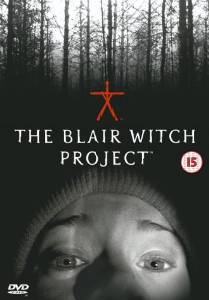
The Blair Witch project 1999

As if to underline audiences’ boredom with standard horror fare, the found footage genre re-emerged at the end of the century with the most profitable independent film in movie history, usurping John Carpenter’s “Halloween”. Three people get lost in a wood on videotape. It really is that simple. What follows divided audiences. Some loved it for its clever use of a very (nonexistant) limited budget and the way it raises your hackles by not showing you what is going on. Others hated it for precisely the same reason. The found footage genre proved an enormous hit, no doubt because it was very cheap to copy. But whether you love it or hate it, this subgenre gave the horror film a new direction, one that would create a whole new set of filmmakers in the ‘Noughties and beyond, and who would exploit rapidly-changing technology to give the studios a run for their money.

The Nineties suffered from the overdose of slasher movies that took place in the Eighties. For a while the genre was left reeling. But new technology and clever filmmaking resurrected the horror movie at the end of the decade. With audiences demanding new thrills, better special effects, and grimmer storylines to reflect the pessimism of the times, horror movies were about to go to a very dark place indeed.

Next time…

Zombies, zombies, zombies! The world goes mad for George A Romero’s creations. Horror goes viral, ghosts turn Japanese, and it seems that anyone can make a horror film as long as they have a mobile phone.