Tag Archives: movies

The Best Horror Movies of the Past 50 Years, Part 2! The Seventies! 1970-1975!

Last time we saw how horror movies changed in the 1960s, from classic Gothic horror like the Hammer films and Roger Corman’s Edger Allen Poe adaptations to pessimistic modern horror stories like “Rosemary’s Baby” or “Night of the Living Dead”. This time we turn out attention to the 1970s – possibly the most exciting time for horror since the Universal monster movies of the 1930s and 1940s.

During this decade, Hollywood proved it was willing to take risks with stories, to go places they had never gone before. Add to this a new tide of horror authors who wanted to update the Gothic horror staples of vampires and werewolves, including a certain Stephen King, and you have a decade of some of the greatest horror movies ever made. In fact, there are so many great horror movies of the Seventies that I’ve had to split this post up! So here are what I think are the most influential horror movies from 1970 to 1975!

blood

A Bay of Blood (1971)

One feature of early 1970s cinema is the debt it owes to cinema verite. Even Spielberg’s “Close Encounters of the Third Kind” owes a debt in places to this documentary-style of film-making. The trend suited low-budget movie-makers and would lead to the infamous slasher movie. The start of that craze can be found here. Part Italian giallo, part murder mystery, “Bay of Blood” was made by Mario Bava, a film-maker who deserves far more recognition than he has enjoyed. A number of potential heirs and heiresses to a fortune are invited to the titular Bay. They then try to kill each other off in various gory and brutal ways. Boasts some bravura set–pieces. The octopus is a great surprise also!

Deliverance 1972

You’ll never play the banjo again. Disturbing hi-jinks in America’s backwoods when some city slickers cross paths with the twisted locals. John Boorman’s gripping horror-thriller features a young Burt Reynolds. Copied many times, sometimes humorously, sometimes not.

Exorcist 1973

This is a movie which probably needs no introduction from me. A supernatural chiller directed by William Friedkin and based on the best-seller by William Peter Blatty, itself based on a supposedly real event. It broke all records when released and became notorious not just for fainting audiences, but for the treatment its stars were subjected to. Today, it’s been copied so many times that it may have lost its power to shock. It has directly influenced every exorcism movie since, as well as forming the basis for the dubious Leslie Nielsen comedy “Repossessed”. Still, as a meditation on the power and seductiveness of evil, it’s compelling.

Sisters 1973

Brian DePalma’s first movie. So demented it’s terrific. Margot Kidder stars as a pair of French-Canadian Siamese twins that were separated with horrific consequences. This is a movie that seeks to turn horror tropes and clichés on its head. Its twists keep going right to the end. It is also part of the illustrious mad-doctor movie that became popular with “Eyes Without A Face” and keeps on going today with movies like “Hostel” and the distasteful “Human Centipede” films.

The Wicker Man 1973

The world’s first horror musical! Fantastic British chiller starring Edward Woodward as a religious police officer who goes to investigate a disappearance on a remote Scottish island where paganism is rife. Although it was remade poorly, this really is a one-of-a-kind movie. Music by folk-rock band Pentangle serves as an atmospheric soundtrack  to what is probably the bleakest ending ever.

Black Christmas 1974

This expertly-made psycho-thriller started the old gag that the killer is making phone calls from inside the victim’s house.A killer is stalking a sorority sisterhood. Margot Kidder again resurfaces, this time as the victim.  A genuinely disturbing movie in some places and a forerunner of the teen slasher movie that was to come.

Texas chainsaw Massacre 1974

Another 70s shocker that has lost most of its power due to continually being copied. It’s hard to imagine the modern psycho-killer movie without TCM. This brutal film began the “endurance horror” craze and took the idea of murderous hillbillies one step further. You actually see very little gore in this movie. But audiences were convinced they saw more, such was the power of suggestion. Today, its ferocity is hard to understand, but on release this was one of the movies that changed the horror landscape and paved the way for the “video nasties” of the 1980s.

Deep Red 1975

Dario Argento’s best movie. This is a true giallo film — a type of Italian thriller that closely identifies with the killer and features elaborate set-pieces. David Hemmings is the American out of his depth who witnesses a murder in Rome. Or did he? A superb mystery with some excellent death scenes. Probably the finest giallo movie ever made.

Shivers 1975

This unsettling sex horror (is that even a genre?) signalled the arrival of Canadian body horror maestro David Cronenberg. The residents of a luxury apartment building are attacked by repulsive turd-shaped parasites that drive the into a sexual frenzy. This is a movie that is bound to deeply disturb anyone remotely normal. Which of course, is great. The body-horror genre has its roots in the Atomic bomb era of the 1950s and the plethora of paranoid B-movies where the main character was mutated by radiation.  Cronenberg made that fantasy disturbing reality, which would lead to many other movies in that genre, such as Clive Barker’s “Hellraiser” and Cronenberg’s own “The Fly” in the 1980s, as well as direct homages such as 2006’s “Slither”.
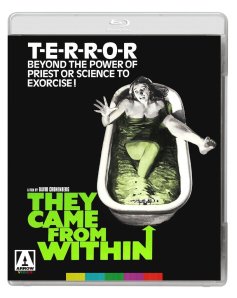
You'll never get into the bathtub again... Cronenberg's "Shivers"!

You’ll never get into the bathtub again… Cronenberg’s “Shivers”!

Jaws 1975

The daddy of summer blockbusters. “Jaws” rewrote the Hollywood paradigm for making movies and still rules the waves. Okay, so the shark looks a bit rubber now. But thanks to a mechanical failure, Spielberg has given us one of the best (and most quotable) thrillers ever made. The movie’s success would lead to other popcorn movies like 1977’s “Star Wars”. As we know, these movies would influence the box-office for decades to come. Not for much longer would studios take a gamble on artistic and risky fare. Eventually, this would lead to the cut-and-paste plots of most big-budget movies today. In a way, “Jaws” sounded the death-knell of the kind of low-budget film-making that created so many different kinds of horror movie in the 1970s.

Next…

1975 – 1979!

Telepathic teenagers go on a rampage, zombies go for a morning stroll in a supermarket, a particularly unpleasant alien hitches a ride on a passing spacecraft, and a certain Michael Myers decides its time he went home…


How to Write Loglines – an actually useful guide

Want to know how to write effective loglines for movies and books? Read on!

INTRODUCTION

There has been so much written on the subject of writing loglines that I thought it was about time I added my tupppence (or two cents, depending on which side of the Atlantic you are on) to the debate.

Let’s start with the basics:

1. WHAT IS A “LOGLINE”?

A logline can apply to both novels and screenplays for movies. They are generally short, punchy descriptions of the plot (i.e. the thing your story is about). Editors, agents, producers and assorted other people often ask for a logline when they are deciding whether to buy or represent your work.

Interestingly, neither Robert McKee in his lauded book “Story” nor William Goldman in his seminal essay “Adventures in the Screen Trade” mention what a logline is. Yet I would argue that is one of the most essential tools the screenwriter or novelist has at his or her disposal. In fact, it is an essential skill to master.

One thing a logline is not is that thing you see on movie posters. This is in fact a “tagline”. Tagllines are very short (usually one sentence, or sometimes less!) statements used to entice someone into watching a movie.

An example of a tagline:

“In space, no-one can hear you scream” (Alien)

While this is a great tagline, note that it tells us nothing about what is going on (other than it’s in space, and you’re likely to scream).

A logline is more sophisticated and tells us more about the story.

For example:

“A psychopath escapes from an asylum and slashes his way through a quiet suburban neighbourhood until he is defeated by a bookish young woman” (Halloween).

Okay, so it’s not poetry. But you get the picture.


2. WHY THE HELL DO I NEED A LOGLINE ANYWAY?

But Eric, you say, why should I distil my 100,000 word novel or my 120 pages screenplay, work of genius that it is, into a single sentence?

The answer: a logline is a selling tool.

Loglines allow you to “pitch” (i.e. tell) someone about your story in a very short space of time. And when you’re dealing with producers, agents and executives who can only spare you less than a minute, this becomes important.

Of course, if you’re happy just writing and never selling anything, loglines probably won’t apply to you. Good luck on your chosen career path. Some of us have to eat.

A good logline can make someone sit up in their seat and pay attention. It can entertain, move and arouse curiosity in the listener. And it can delay that moment when they start yawning or hang up.


3.  OKAY, SMARTYPANTS. WHAT IS A GOOD LOGLINE MADE UP OF?

Opinions abound on this.

In his excellent guide “Raindance Writers Lab: Write and Sell the Hot Script”, Elliott Grove suggests that you first come up with a “basic premise”. This, to me, is a logline: a 25 words or less summary of the plot.

A rule of thumb is, the shorter the logline, the higher the concept.

High concept is what sells in Hollywood (although other types of film also sell). What is a high concept? Basically, something that’s real easy to sell.

In “Save the Cat” by Blake Snyder (a book no screenwriter should be without)  the author says that a killer logline should include the following:

– Irony

– A compelling mental picture

– An idea of audience and cost

– A killer title

Let’s investigate:

Irony

What is Irony? In the film “Borat” , Sascha Baron Cohen in his alter ego of the Khazakstanian ambassador to the USA, interviews a real-life professor of comedy. When the Professor tries to explain a joke to him, Borat deliberately gets the wrong end of the stick repeatedly. This goes on for some time until it becomes very funny. Everyone but the Professor of comedy, who is paid to understand humour, gets the joke. That is irony.

An example of irony in a logline would be: “A lawyer is forced to tell the truth for 24 hours after his son makes a birthday wish ” (Liar Liar).

The other elements are all important. A title is essential to help your movie stand out from the crowd. A sense of scale and budget will help others to decide whether to invest (is it “The Blair Witch Project” or “Avatar”?) .

However, there are basic elements I think this definition leaves out.

The easiest way to analyse what makes a good logline is to look at one.

Here are two examples:

“A police chief with a phobia of the sea must kill a giant shark but faces opposition from the local mayor who demands that the beaches stay open” (Jaws).

“A naive farmboy on a distant planet learns that he is actually the son of a legendary warrior and sets out to rescue a princess from an evil galactic empire”. (Star Wars).

Here we can see irony at work. The police chief is afraid of the water but must fight a shark. The farmboy is naive but must somehow defeat a whole army.

But there is more than just irony in a logline. Looking at our examples, here are some common elements:

A PROTAGONIST in an IRONIC SITUATION must overcome an OBSTACLE to achieve a GOAL in an ARENA.

Tackling “Jaws” first:

“A police chief [PROTAGONIST] with a phobia of the sea [IRONY] must kill a giant shark [GOAL ] but faces opposition from the local mayor [OBSTACLE ] who demands that the beaches stay open [ARENA]”.

The ARENA is the environment the story takes place in. This could be a location (a distant planet), a particular organisation (for example, the mafia), or even within the family unit (see “Ordinary People” for an example).

Sometimes the ARENA will be implicit. Other times you will have to spell it out. But the logline should give a sense of this.

Note that the OBSTACLE may be the same as the ANTAGONIST, or it may not. In “Jaws”, you may think the antagonist is the shark. But in fact it is the local mayor who opposes Brody’s shark safety measures. Killing the shark is the GOAL.

In “Star Wars” the antagonist is Darth Vader (or Grand Moff Tarkin to be precise). But in fact the whole Empire is what poses the problem.

The point is, the OBSTACLE is a fluid concept, depending upon how you craft your logline. But I believe there is an optimum balance to be achieved for maximum effect.

Here is another example that shows the flexibility of the logline concept:

“A young man and woman from different ends of the social spectrum fall in love aboard an ill-fated ocean liner.” (Titanic)

Breaking it down:

“A young man and woman [PROTAGONIST] from different ends of the social spectrum [OBSTACLE] fall in love [GOAL] aboard an ill-fated ocean liner [ARENA and IRONY].”

Note that it is the young woman who is the protagonist. More on that in another post. But the story is always about ONE PERSON’s journey. Unless it’s an ensemble film. Which just goes to show that William Goldman was right when he said “Nobody knows anything”!

One more for the road:

“A loyal Roman general is betrayed and his family murdered by an insane Emperor and returns to Rome as a gladiator to seek revenge” (Gladiator)

Here’s the breakdown:

“A loyal Roman general [PROTAGONIST] is betrayed [IRONY] and his family murdered by an insane Emperor and returns to Rome as a gladiator [OBSTACLE and ARENA (literally!)] to seek revenge [GOAL]”.

Note also that sometimes it is the Protagonist’s FLAW which provides the irony (such as the farmboy being naive in “Star Wars” or the police chief with a phobia off the sea in “Jaws”). Other times it is the entire situation which is ironic, such as the loyal Roman general who is enslaved and betrayed by his own Emperor. Again, it’s a flexible concept.

The important thing is not to get hung up on the details but to check all the boxes.

One last thing. It may be worth your while to develop the logline BEFORE you write the script, as this way you can build a story that has the strongest foundations possible.

IN SUMMARY

So there you have it:

PROTAGONIST + IRONIC SITUATION + OBSTACLE + GOAL + ARENA

Not necessarily that order!

Have fun with loglines. You will probably take quite a few goes to build the best logline for your story. But the rewards are worth it. A logline is the PRIMARY selling tool. Once you practice it, you will surprised at the results.


13 Modern Horror Authors you must read ?

Horror has always been the unloved bastard lovechild of fiction. This is no more so than now. Horror books are often derided as puerile or unsavoury. Horror films are often accused of exploitation. Worse still, in recent years, horror fiction has often been diluted and warped into “dark fantasy”, thanks to TV shows like “Buffy the Vampire Slayer” and the innumerable “paranormal romance” novels that litter the bookshelves.

But for those who like their horror fiction a little more mature, a little stronger, a little darker, it’s time to share with you my personal love of the horror genre. So here is a compendium of what I think are 13 of the greatest contemporary horror authors.

(One side note: by contemporary, I mean since the 1970s. I struggled to compile a list of more recent authors who ranked alongside these greats. Feel free to agree or disagree.  But for argument’s sake, here are my thirteen, in no particular order…)


STEPHEN KING 

Okay, let’s get this one out of the way. Everybody knows King’s work, thanks to the hugely successful movies. However, the films do not capture the essence of King, which is his style. Often very detailed to the point of making you believe you are there, his collloquial storytelling manner immediately disarms you. Perhaps his most successful novels (in terms of evoking fear) are “The Stand” and “IT”. But for a real treat, check out his short stories in “Night Shift”.


JAMES HERBERT 

King once wrote that Herbert was not a great writer, but a great novelist. Whatever the truth of that, when you read a Herbert novel, you are soon unable to put it down. Pages turn with greater and greater rapidity toward an often brutal and apocalyptic conclusion. His novel “The Rats” still aches to be made into a decent film. But for sheer insane brilliance, try “Domain”. “The Fog” also sees Herbert at his catastrophic best. Sadly missed since passing on recently.


CLIVE BARKER

The enfant-terrible of horror. Barker has been at it since the 80s, when Stephen King declared him the future of the genre. Belonging more to the school of body-horror than classic scares, Barker’s novels create a fantastical nightmare world where anything is possible. Not satisfied with writing, Barker directed his own novella “Hellraiser” to enormous success. But for me, his novel “Cabal” , filmed as the underappreciated “Nightbreed”, is his best. With the Hollywood machine currently churning its way through his gigantic short story collection “The Books of Blood”, Barker  is sure to remain a popular name in the genre.


ANNE RICE

A totally different entity, Anne Rice has been quietly crafting brilliant, haunting gothic stories since the 1970s. Her Vampire Chronicles have spawned about ten sequels, as well as one good movie and one not very good one involving her most famous creation, the vampire Lestat. Her Mayfair Witches stories are just as good. No serious horror fan should miss her books.


RICHARD MATHESON 

Here’s where it gets interesting. Matheson was a prolific contributor to Rod Serling’s “The Twilight Zone” before penning “Duel”, a young Steven Spielberg’s first feature, as well as “I Am Legend”, a novel that has been made into two very different movies starring Will Smith and Charlton Heston. Capable of writing paranoid sci-fi/horror (“The Incredible Shrinking Man”) to tear-inducing romantic fantasy (“Somewhere In Time”, “What Dreams May Come”). Again, he passed away a few years back, but left us with a truly memorable body of work.


RAY BRADBURY 

The king of the short story, Bradbury penned the screenplay for “Moby Dick”, as well as the seminal sci-fi classics “It Came from Outer Space” and “The Beast from 50,0000 Fathoms”. His novel “Something Wicked This Way Comes” was once made into a Disney movie, of all things! Also a master of science-fiction, Bradbury wrote “The Martian Chronicles”. But his most eerie stories, almost mythic in tone, can be found in “The October Country”.


PETER STRAUB 

Straub’s work has never enjoyed the mainstream success of his sometime co-writer Stephen King. He also often chooses to write mystery novels. However, his titanic supernatural masterpiece “Ghost Story” is one of the best modern books in the genre (once made into a rather forgettable movie with Fred Astaire and Ray Milland). His other horror fiction, such as the feverish “Julia”  and “If You Could See Me Now” is rife with ghostly happenings that seem sso realistic, you could almost miss them. A very sophisticated writer who wields a pen as sharp as a scalpel.


CHARLES L GRANT 

Although not as well known as he should be, Grant was immensely prolific, writing under several different pseudonyms and in different genres. His major achievement in horror fiction was creating the town of Oxrun Station, introduced in “The Hour of the Oxrun Dead”. His dreamy, poetical style often starts with a slow burn and then reaches a terrific climax. Reminiscent of the “classic horror” movies of the 40s, Grant’s prose dwells less on gore and more on atmosphere and suspense. Another writer who sadly is no longer with us.


RAMSEY CAMPBELL

A writer of weird fiction, Campbell is perhaps the most successful horror novelist to come out of Britain besides Barker and Herbert. His fiction is characterised by the bizarre breaking through the mundane world. His short story collection “Demons by Daylight” and his novels “The Doll Who Ate His Mother” and “The Parasite” are all highly recommended.


ROALD DAHL

Yes, that Roald Dahl. The man who gave us “Charlie and the Chocolate Factory” and “James and the Giant Peach”. Come to think of it, wasn’t “Charlie and the Chocolate Factory” always rather frightening? Dahl also penned some deliciously twisted short stories with a classic twist in the tale in his collections “Kiss Kiss” and “Someone Like You”. In fact, they made a whole TV series out of them, appropriately called “Tales of the Unexpected”


RICHARD LAYMON 

Deserves inclusion on this list simply by virtue of being so prolific, if nothing else. Laymon’s novels are not for everyone. They tend to be as subtle as a brick wrapped in bloody innards. However, their breakneck speed drags you along until the last chapter. So high-concept, it makes you wonder why Hollywood hasn’t bothered with them. Check out the brilliant “Among the Missing” or the downright bizarre “Beast House”. Whether you like his work or not, Laymon’s huge output has helped keep the horror market afloat. Yet another writer who recently passed away.


There were more that I felt could have been included here: Graham Masterson, Fritz Lieber, Virginia Andrews, William Peter Blatty, TED Klein, Robert R McCammon, Whitley Streiber and Robert Bloch to name a few. However, although it surprises me, my thirteenth place goes to…


J.G. BALLARD

“Ballardian” has become a phrase to describe the bleakness of modern living. As well as providing fodder for Hollywood with the likes of “Empire of the Sun” (a horror story if ever there was one), Ballard wrote the auto-erotic (in a literal sense) “Crash”, filmed by David Cronenberg. His other works include a novel about a man marooned on a traffic island and a whole apartment complex of people who go insane. Fitting metaphors for the horror of “modern living”, where we can connect anywhere on the planet but still remain isolated. A rare example of a horror writer who was lauded by the literary establishment during his lifetime, Ballard passed away in 2008.


So there you have it, my top 13 horror authors. Each has a distinct voice, from the Gothic to the frighteningly modern. You may also notice that there is a substantial lack of new blood in the field (pun intended). Who will fill the void?

Will it be you? 


Bonus post! How to write Hollywood action lines part 3!

Here is something that trips me up time and time again, and I’ve seen even the most seasoned screenwriters falls for it. So I thought I would include it in this bonus post about how to write Hollywood-style action lines in your screenplay.

This tip can be summed up in one word:

EDIT.

What I mean is, you should always be trying to REMOVE UNNECESSARY WORDS.

Do you have a screenwriting bible?

I do.

It contains everything I’ve ever leant about screenwriting in bullet point form. Only I can understand it, which is fine because it’s only for my use. But in it, I’ve written down the words I should try to avoid at all costs.

And now I’m sharing them with you.

So here they are:

“But”

“And”

“As”

“Is/Are/Am”

“Both”

“Then”

“Just”

“We See”

Please note: if you read a lot of produced screenplays written by professional screenwriters, you will probably see these words being used over and over again. The difference between them and you?

They got paid already.

Another point worth mentioning is: don’t go overboard. If you include one “but” in a 110 page script, chances are it won’t make any difference. Also, if you edit your action lines down too much, they may not make sense. Removing every “a” or “the” will confuse the reader. Sometimes you might even want to deliberately break the rules to make more of an impact on the reader.

So use common sense.

But before you start marketing your script, a simple search for these words will allow you to edit them out of existence and strengthen your action lines. And that might be enough to tip the scales in your favour.

Now if only I’d used this tip on my last script…

How to Write Hollywood-Style action lines Part 2!

Here is the second chapter of how to write action lines.

Now, I’m not professing to write like any of the people whose work I’m about to discuss. However, I have noticed certain things which we as writers can do to make our action lines more professional. And this isn’t just for screenwriters, either. I believe that everyone (myself included) would benefit from analysing the style of the masters.

That said, I’m going to begin with a non-screenwriter.

Stan Lee is a comic book legend. The man who invented Spider-Man, the Fantastic Four, and many many more. Comic book style is even terser than screenwriting. They only have one caption to get across a lot of information.

Here is a passage I read from the Amazing Spider-Man a while ago:

“You’ll see Spidey turning to a psychiatrist for help after he becomes convinced he may be going mad! And wait’ll you learn who the mysterious shrink himself turns out to be. Next, our hero has to a battle a seemingly indestructible robot, and if that isn’t enough, the deadly mechanical marauder is actually controlled by the sneering, leering, J. Jonah Jameson himself!”

Notice anything?

If you’ve ever heard Stan the Man talk, you can probably hear his intonation ringing in your head right now. But let’s boil it down to some simple rules.

Let’s take another look:

“You’ll see Spidey turning to a psychiatrist for help after he becomes convinced he may be going mad! And wait’ll you learn who the mysterious shrink himself turns out to be. Next, our hero has to a battle a seemingly indestructible robot, and if that isn’t enough, the deadly mechanical marauder is actually controlled by the sneering, leering, J. Jonah Jameson himself!”

Lee’s style is so bold that generations of comic writers have mimicked him. Here we see several of Stan’s tell-tale traits at work. And if that isn’t a clue, nothing is!

Notice the sentence structure contains adjectives before most of the nouns (except for the proper noun ‘Spidey’, which is really a name). You have a “mysterious shrink”, a “seemingly indestructible robot”, and a “deadly mechanical marauder”.

Which brings us to our next Stan Lee trait: alliteration (words that begin with the same letter for those without an English degree). Phrases like: “Mechanical marauder”, and of course J. Jonah Jameson himself. Many more Stan Lee heroes are alliterative, too. Like Peter Parker, Bruce Banner, and Matt Murdock. Lee once said he did that on purpose so he could remember the names, but whatever the reason, it makes the phrases have even more impact.

There you go, two simple ways to make your action lines stand out: alliteration and adjectives.

However…

Just remember that screenplays are also sparse. They are images. Easy to follow. Easy to read. Mainly written in high school English. So do don’t go jumping for your Thesaurus just yet.

Consider this passage:

“The front of the Opera House is open only to foot traffic these days. A bizarre place on a Friday night, hawkers and whores, the rabble, the poor and the curious mill around the crudely built platforms and brightly lit stands. Zhora, in just a translucent raincoat, is not out of place in this flea market atmosphere. Trying not to run, she slices through the mob as quickly as she can. Deckard is not far behind, dodging and side-stepping, trying to move against the tide of people scurrying for shelter

She comes to an intersection and turns out of the mall onto a less crowded street. She glances over her shoulder as she breaks into a run and runs right into a couple of pedestrians. All three go down.

Deckard comes out of the crowd in time to spot her getting to her feet. She sees him and runs. The two pedestrians are in his line of fire. He runs past them and drops to one knee, leveling his blaster

DECKARD

Stop or you’re dead!

She doesn’t.”


That’s an excerpt from the screenplay “Bladerunnner” by Hampton Fancher and David Peoples, based (very loosely) on the novel by Phillip K Dick.

Let’s take a closer look:

The first paragraph sets the scene with a beautiful description that is little more than implied. But there are those adjectives again: “crudely-built”, “translucent”. However, as the action builds momentum, the prose becomes sparser and leaner. The sentences grow short. Simple. Fast. The pace builds until the climax…

Here, the screenwriters use sentence structure to create a sense of energy and pace. The action-filled nature of the scene is also emphasized by the strong verbs and tenses. Zhora “slices through the mob” Notice, she “slices”. She doesn’t just run or walk through them. This creates a feeling that she is powerful and determined. Meanwhile Deckard dodges and side-steps. He has to get out of people’s way. He is her physical inferior.

As the pace quickens, the verbs become even leaner: Zhora turns, glances, runs,  until she collides with more pedestrians.

A useful rule is to try to get rid of any “is” verbs. Is running. Is walking. Is grabbing. Is talking. These are static words that slow the reader down. Better to say he or she runs, walks, grabs, talks.

Time for a third example:

The granddaddy of all powerful prose has to be Robert E Howard, with his Conan stories. You will see similar patterns to Stan Lee in his work, which is effortless to read. Here is an excerpt from Conan’s battle with a sorcerer in “Black Colossus”:

“He cast his staff and it fell at the feet of Conan, who recoiled with an involuntary cry. For as it fell it altered horribly; its outline melted and writhed, and a hooded cobra reared up hissing before the horrified Cimmerian. With a furious oath, Conan struck, and his sword sheared the horrid shape in half.”

Notice the adjectives (marked in italics). Also notice the strong verbs: “He cast”, Conan “recoiled”, it “fell”, his sword “sheared” it in half.

I’ve found that a simple sentence structure works best:

adjective +subject + verb + adjective + object.

However, as with everything to do with writing, feel free to be as creative as you like.

In pointing out these stylistic devices, I’ve tried not to be prescriptive. However, Howard’s prose is extraordinarily powerful, as is Stan Lee’s, with its jokey, friendly, informal tone. While other screenwriters like David Peoples carve out lean, action-packed sentences to speed up the action.

By far the best way to discover what works is to read screenplays. I cannot emphasize enough how important this is. Only then do you get a sense of what a Hollywood script looks like. And then, of course, you can find your own voice as a writer.

But that is a post for another time!


Screenwriting Contests. Are they worth it? What are the best ones?

There are tons of screenwriting contests out there. Many of them charge a hefty fee just for the privilege of considering your work. But are they worth it? And what are the best ones? Indeed, how do you tell what is “best” when entering a screenwriting contest?

The first contest I ever entered no longer exists. I studiously ignored the rules about formatting, had my script professionally bound at the local Staples, paid my $40, and waved goodbye to it in the mail.

Nowadays, I like to think that I know a little more than that.

For me, it’s all about a “risk to reward” ratio. Before you shell out your hard-earned $45+, I ask:

How big is the contest you are entering?

What are the prizes?

What will you achieve if you win or place?

The bigger the contest, the more competition. Do you enter a massive international contest like the PAGE Awards with thousands of other entrants, or do you target the latest niche contest for horror screenplays?

What are the prizes? Is it a $50 check and some software, or is it $10,000? Some contests like Trackingb.com don’t even offer a cash prize. The “prize” is that you get your script shopped to some very influential people. Is it worth it? Well, that’s up to you. Some contests even promise to make the winning script. In my book, that is priceless. But will it lead to anything? Again, like most things in showbiz, it’s uncertain.

“What will you achieve if you win” is for me the most important question to ask yourself. Many sources state that there are a few contests that Hollywood truly sits up and takes notice of. For instance, in his excellent book Breakfast with Sharks, Michael Lent states that the top screenwriting contests include:

The Nicholl Fellowships

The PAGE Awards

Austin Film Festival

Final Draft’s Big Break contest

Disney/ABC Writing Fellowship (sadly unavailable outside the USA)

The Sundance Institute (for USA writers only; however they do host an international screenwriters’ lab in Utah if you have a spare month or so and manage to be one of the 6-8 screenwriters they choose from the rest of the entire world!)

He also lists some others that no longer exist. I would add:

Trackingb.som

So, as the title of this blog is “The Hard Way to Hollywood”, let’s assume that, like me, you are British. That leaves five screenwriting contests that, according to Lent, appear to be some of the few contests that have truly sparked A-list careers. For example, Andrew W Marlowe (Air Force One, End of Days), Doug Atchinson (Akeelah and the Bee), and Allison Anders (Gas, Food, Lodging) all won Nicholls Fellowship Awards.

Sort of narrows it down, right?

Maybe not…

Did you notice all the qualifiers in those earlier sentences?

I would not discount the smaller contests. They may provide you with a nice, fat check (or cheque, as we say in England) that will keep you going for a while longer. Or they may open doors and work very hard for you and your script. There are plenty of success stories associated with other contests, such as Script Pipeline or Scriptapalooza. So the field is not perhaps quite as narrow as I have led you to believe. 

Another factor in your decision whether to enter a contest may be where you are right now in terms of skill and experience. Before the website was discontinued, I used to regularly place in WriteSafe.com’s monthly contest. No money. But it looked good on my fledgling CV (or resume, if you’re from the USA). Did it get me anywhere? Maybe, in small steps.

So I can’t tell you whether it’s worth entering in screenplay contests. Only you can do that.

There are, of course, many A-list screenwriters who never won a screenplay contest.

Also, depending upon where you are in your career, you may choose to go for a smaller contest with less competition, but which is going to net you valuable connections and where the organizers are going to work harder for your script.

One last thing: it pays to check out the genre of scripts that have previously won. There is little point sending your zombie slasher movie to the Nicholls unless it speaks to something new in the human condition. But then again, you never know!

To find a complete list of contests, check out the ever-reliable http://www.moviebytes.com.

Monday blog tour!

My thanks this morning to fellow Mancunian speculative fiction writer and novelist Graeme Shimmin who nominated me to be the next person on the Monday Blog Tour. A pass-the-baton exercise bringing you blogs from different writers to start your week off on the right track!

What are you working on?

Between writing screenplays, I like to keep myself occupied by writing lengthy horror novels and short stories.

At the moment, I’m just waiting for my sci-fi/horror novel “Project Nine” to be published by myinkbooks.com. The good folks over there picked up my novel last year, and have been busily trying to convert my rather “eccentric” punctuation and spelling into something the public can actually make sense of.

What is it about?

Ah. The magic question.

“Project Nine” is about a young man who longs for immortality. He finds it in a beautiful woman who has escaped from a secret government research program that has created vampires through gene therapy.  He joins her and her friends who have also escaped in their endless trek across America’s backwoods, only to find himself hunted by a relentless detective and losing his own humanity in the process.

How does it differ from others in the genre?

If the Naughties have been so far filled with horror movies populated by twenty-something kids with six-packs and hair extensions, “Project Nine” is about as far from that kind of thing as you can possibly get.

It’s gritty, realistic, and psychologically believable. But it also has the large scale and operatic quality of classic horror stories. I aimed to balance the grim realism of modern fiction with the more emotionally-resonant horror of the 1970s and 1980s.

The vampires in this story are not cape-wearing cliches, nor are they gorgeously, seductive creatures. They are real people put in an extraordinary situation. They make good and bad choices. And they are capable of acts of kindness or unspeakable wickedness.

Why do you write what you write?

Why indeed. Who knows what evil lurks in the mind of Man? Not me, certainly. In my defence, I blame watching a steady diet of old Universal and Hammer horror movies when I was a kid. Rod Serling’s “Twilight Zone” stands out for me as being the best SF/Horror TV series ever made.

However, the first movie that really made my hair stand up on end was actually not a movie at all, but the truly frightening Made-For-TV, 2-part adaptation of Stephen King’s “‘Salems Lot” — the one with David Soul and James Mason. Man, that was scary.

Essential, late-night, family-friendly viewing!

Essential, late-night, family-friendly viewing!

I’ve also been an avid fan and collector of comics since I was knee high to an Inhuman. Marvel and 2000AD to be precise. People like Alan Moore have been a huge inspiration, especially “Watchmen”  and his run on DC’s “Swamp Thing”.

As far as “real” literature goes, HP Lovecraft remains for me the greatest master of the craft. I also devoured novels by Stephen King (although I especially like the short stories in his “Night Shift” collection) and the criminally underestimated British king of horror, James Herbert. Other influences include: Peter Straub, Frank Herbert, Terry Brooks, Anne Rice, Phillip K Dick, Harry Harrison and, of course, Ray Bradbury.

There. You asked for it.

Swamp Thing - the thinking man's horror comics.

Swamp Thing – the thinking man’s horror comic.

What is your writing process?

You mean I have a process?

Seriously, it all depends on whether I’m writing screenplays, novels, or short stories.

Screenplays tend to be very structured. I outline to a varying degree of depth before writing a first draft. Then I use a structured rewrite process. I recommend reading as many books as you can on the subject and then employing the rewrite proceess used by Paul Chitlik in his excellent book. Then repeat. Over and over again. And again. And again.

My novels are a different animal. My first novel started life as a comic script (now lost, sadly) and then grew into a full-length book. My second, unpublished work began life purely as a novel. I had a rough idea of what I wanted to say and what the theme would be, then I started writing. Now I’m in the process of getting peer feedback before rewriting and editing.

Short stories usually come out of the blue. I get a first line or an idea as I’m in the shower or walking down the street and then I run with it. The ones that pop into my head seem to be the most successful. The ones I agonize about and outline never see the light of day. Weird, eh?

How much do you write in a day?

Depends. I just wrote an entire screenplay in five days. When I was in what I like to call my James Joyce phase I could write ten pages of single-spaced prose on my typewriter (yes, I had one of those). That comes to about 350 words a page. So 3,500 words a day.  You nosey parker, you.

Previous Writer

I was asked to contribute to this project by Graeme Shimmin  as part of a chain of connections from writer to writer. Each writer answers the questions and then links to the next writer in the chain. Graeme writes mainly alternate history and some excellent short stories. I suggest you check out his intriguing, fact-filled blog.

Next on the Tour

Graeme Cole is a filmmaker extraordinaire and bon vivant who also writes absurdist fiction. He currently resides in Bosnia and runs L’Institute Zoom, which maintains a blog here.

Andrew Bellware is a sci-fi/fantasy/theatre director/writer/actor and all-round swell guy who works out of NYC. He and his producing partner run Pandora Machine Films, which maintains its eponymous blog (Rated “R” for some racy content — you have been warned). I recommend their marvellous movie Clone Hunter, written by some guy from England 😉

Clone Hunter - the greatest science-fiction ever made, apparently!

Clone Hunter – the greatest science-fiction ever made, apparently!

Intermission – how to calculate movie budgets

Before we carry on with our discussion of action lines, here is something I learned about movie budgets.

One of the most popular questions asked of screenwriters is “What is the budget of this movie”? Yet there are no websites I can see which offer guidance on this. So, to fill a gap I thought I would share my research with you, gentle reader…

It can be frustrating for a screenwriter trying to estimate his or her potential screenplay’s budget. How much do SFX cost? How much does it cost to shoot in a particular city or range of locations? Will those exotic wild animals bump up the cost?

The only way I’ve found any answers is to look at previous movie budgets. Now, inflation can be a vexing devil, so I’ve only gone back a few years in most cases.

Here’s a list of recent movies from a range of budgets, along with what it cost to make them (All numbers are taken from http://www.boxofficemojo.com):

BIG BUDGET
Man of Steel = $225 million
Iron Man 3 = $200 million
World War Z = $190 million
Fast & Furious 6 = $160 million
Gravity = $100 million

MEDIUM BUDGET
Crazy Stupid Love= $50 million
Zero Dark Thirty = $40 million
The Social Network = $40 million
The Rite = $37 million
Saving Mr Banks = $35 million
Looper = $30 million
Anchorman = $26 million
The Conjuring = $20 million
The Apparition = $17 million
Nebraska = $12 million

LOW BUDGET
Paranormal Activity 2 = $3 million
The Purge = $3 million
Last Exorcism = $1.8 million
Insidious = $1.5 million
The Devil Inside = $1 million

MICROBUDGET

Paranormal Activity = $15,000

What does this mean? Well, let’s break it down.

BIG BUDGET

At the top end, we have big budget tentpole studio movies crammed with SFX and bankable stars. If you can make one of these for under $100 million, good luck. This is a very small market. Studios may only make a handful of these a year. Most of them are adaptations. Competition is fierce, and writing jobs are usually assignments that are  given to writers with a proven track record for generating serious cash. Here you will find your Joss Wheedons, David S Goyers and Zack Snyders.

MEDIUM BUDGET

In the middle range we have movies that are between £10-$100 million. This is a big range, and may movies are made for this amount of money. Factors that can push your script into this bracket include SFX, a few bankable stars, or lots of animals and stunt scenes. So if you’re filming Tom Hanks, Anthony Hopkins, or Steve Carrell, or your script calls for a family of tigers, or a scene where someone jumps onto a moving semi-trailer (that’s a lorry for those of you who are English), or a wise-cracking CGI alien, this is likely to be your budget range. Again, there is tough competition here. Writers like Aaron Sorkin have made this budget range their own. But it may be possible to break into this market if you have a seriously strong concept and story that attracts star caliber talent or high-level investment. Note that many of these are dramas or dramedies. That’s because it’s tough to get a drama made unless you have a star, or an ex-star that wants to come back. Both of whom can push your low-budget piece up into this category.

LOW BUDGET

Next, we have the low budget world. This is the easiest spot to aim at. Most of these movies have either no SFX, a limited cast, are contained (i.e. they have limited locations, ideally less than 4), or are found footage. This is the world of the TV or family movie, However, it is also notably dominated by the horror genre. Horror has been the proving ground for many directors who went on to be A-listers (Steven Spielberg, Peter Jackson) and tends to feature actors who can carry a movie without having the ego or bank account of so-called “stars”. A good horror movie can break box-office records, and studios know this. For instance, Insidious (2011) cost only £1.3 million to make, yet grossed over $55 million. Compare that to infamous flop “John Carter” (2012), which cost $250 million yet has recouped only $75 so far.

MAICRO-BOUDGET!!!!

Finally, we have the weird and wonderful world of the microbudget movie. This can be the kind of thing that premieres on the horror channel (if anywhere), or the kind of megahit that makes an entire career. Again, horror tends to dominate. Paranormal Activity, The Blair Witch Project, and Halloween all became the most profitable independent films ever at one time. However other genres proliferate, such as 1980s sci-fi cult hits like Charles Band’s Trancers. However, it’s pretty safe to say these are flukes.

In reality, the low budget movie seems like a more sensible place to start. However, a word of warning: limiting your ideas to deliver a tiny budget movie may be a mistake. My own movie “Clone Hunter” was written as a big-budget space opera, yet managed to translate into a much lower budget movie. However, I’ve written microbudget movies by shoe-horning my ideas into confined locations without any SFX, and these failed to ignite any interest.

In my opinion, it doesn’t hurt to put your eggs in different baskets. You can always try for a big-budget payoff while honing that indie coming-of-age drama and rattling off that limited location found footage horor movie.

Like everything with writing, it seems there’s no single surefire quick access route to success. Sometimes it’s just a matter of writing what excites you and finding someone who is as passionate about your material as you are. If nobody else shares your vision, move on.


How to Write Hollywood-style action lines — part 1

Today, here are some tips on how to do the above – write action lines like the ones you see in Hollywood screenplays. Style can make or break a script, or turn a great story into a terrible script.

The main aim of all stylistic devices in a screenplay is… to get the reader to read yor script.

That’s it.

So how do you do that?

Create suspense.

Use short sentences.

Make it a vertical reading experience.

See?

 Here are some examples:

The “vertical” style was perhaps most famously used in “Alien”. Here is a sample taken from the revised script by Walther Hill and David Giler, based on the original script by Dan O’Bannon and Ronald Shusett:

“SOMETIME IN THE FUTURE:

INT. ENGINE ROOM

Empty, cavernous.

INT. ENGINE CUBICLE

Circular, jammed with instruments.
All of them idle.
Console chairs for two.
Empty.

INT. OILY CORRIDOR – “C” LEVEL

Long, dark.
Empty.
Turbos throbbing.
No other movement.

INT. CORRIDOR – “A” LEVEL

Long, empty.

INT. INFIRMARY – “A” LEVEL

Distressed ivory walls.
All instrumentation at rest.”

Pretty obvious why it’s called the “vertical” style, right? The aim is to make the reader’s eye naturally flow down the page thus causing him or her to TURN OVER and start reading the next page. Do that enough times and the reader will actually finish your screenplay.

But you don’t need to be so drastic. Back in 1978 that was fresh writing. Nowadays it’s more a throwback. Also, this tends to use up a lot of pages.

Here’s a slightly more modern example, from a draft of “Scream” written by Kevin Williamson:

“FADE IN

ON A RINGING TELEPHONE.

A hand reaches for it, bringing the receiver up to the face of
CASEY BECKER, a young girl, no more than sixteen.  A friendly face
with innocent eyes.

CASEY
Hello.

MAN’S VOICE
(from phone)
Hello.

Silence.

CASEY
Yes.

MAN
Who is this?

CASEY
Who are you trying to reach?

MAN
What number is this?

CASEY
What number are you trying to reach?

MAN
I don’t know.

CASEY
I think you have the wrong number.

MAN
Do I?

CASEY
It happens. Take it easy.

CLICK! She hangs up the phone.  The CAMERA PULLS BACK to reveal
Casey in a living room, alone.  She moves from the living room to
the kitchen.  It’s a nice house.  Affluent.

The phone RINGS again.

INT.  KITCHEN

Casey grabs the portable.

CASEY
Hello.

MAN
I’m sorry. I guess I dialed the wrong number.

CASEY
So why did you dial it again?

MAN
To apologize.

CASEY
You’re forgiven. Bye now.

MAN
Wait, wait, don’t hang up.

Casey stands in front of a sliding glass door.  It’s pitch black
outside.

CASEY
What?

MAN
I want to talk to you for a second.

CASEY
They’ve got 900 numbers for that. Seeya.

CLICK!  Casey hangs up.  A grin on her face.

EXT.  CASEY’S HOUSE – NIGHT – ESTABLISHING

A big country home with a huge sprawling lawn full of big oak
trees.  It sits alone with no neighbors in sight.

The phone RINGS again.”

This is a nice, flowing style that leads your eye down the page. Notice how the sentences are short. Clipped. And, in some cases, incomplete.

There is also far less detail than you think in these lines. The writers were adept at using minimal words to convey a setting. The reader’s mind fils in the blanks. In fact “Alien” uses only two words to describe a spaceship’s engine room.

So the next time you think about adding a ten-line paragraph to explain that this is a comfortable, well-furnished craftsman-style house that nestles on the edge of town surrounded by sycamore trees with a luxury car parked on the drive outside… think again.

Which brings me to my second tip .

Don’t overdo it.

Some sentences belong together. When you try to force them into a vertical pattern, you actually break the flow and make it more difficult to read down the page. For example, here’s a passage from the script of “The Bourne Identity” by Tony Gilroy, based on the novel by Robert Ludlum:    

INT. FISHING BOAT BUNK ROOM — DAWN — TIME CUTS

Transformed into a makeshift operating room.  A light swings
overhead.  THE MAN layed out across the table.  Sounds —
groans — words — snatches of them — all in different
languages.

GIANCARLO playing doctor in a greasy kitchen apron.  Cutting
away the clothes.  Turning THE MAN on his side.  Two bullet
wounds in the back.  Probing them, judging them.

Now — GIANCARLO with a flashlight in his teeth — TINK —
TINK — TINK — bullet fragments falling into a washed-out
olive jar.

Now — something catching GIANCARLO’S EYE — A SCAR ON THE
MAN’S HIP — another fragment — exacto knife cutting in —
tweezers extracting A SMALL PLASTIC TUBE, not a bullet at
all, and as it comes free —

THE MAN’S HAND SLAMS down onto GIANCARLO’S”…

This is still a pretty vertical read. However it would have been even more vertical to separate each sentence out onto separate lines, like so: 

“Transformed into a makeshift operating room.

A light swings overhead.

THE MAN layed out across the table.

Sounds — groans — words — snatches of them — all in different languages.

GIANCARLO playing doctor in a greasy kitchen apron.

Cutting away the clothes…”

And so on. But does this make it any better? No. Sometimes it’s worse to force the reader to look at a new line. The most important thing is to preserve the flow. I’ve read lots of amateaur screenplays where the writer thought they were doing the reader a favour by splitting lines up in this way. But  it actualy makes it harder to read them.

It’s a judgment call. And the best way to decide is to look at other scripts. There are plenty of them on the Internet these days. Break them down the way you would an Enlgiash Literature exercise.

And that’s exactly what we’ll be doing in Part 2.

See you then!